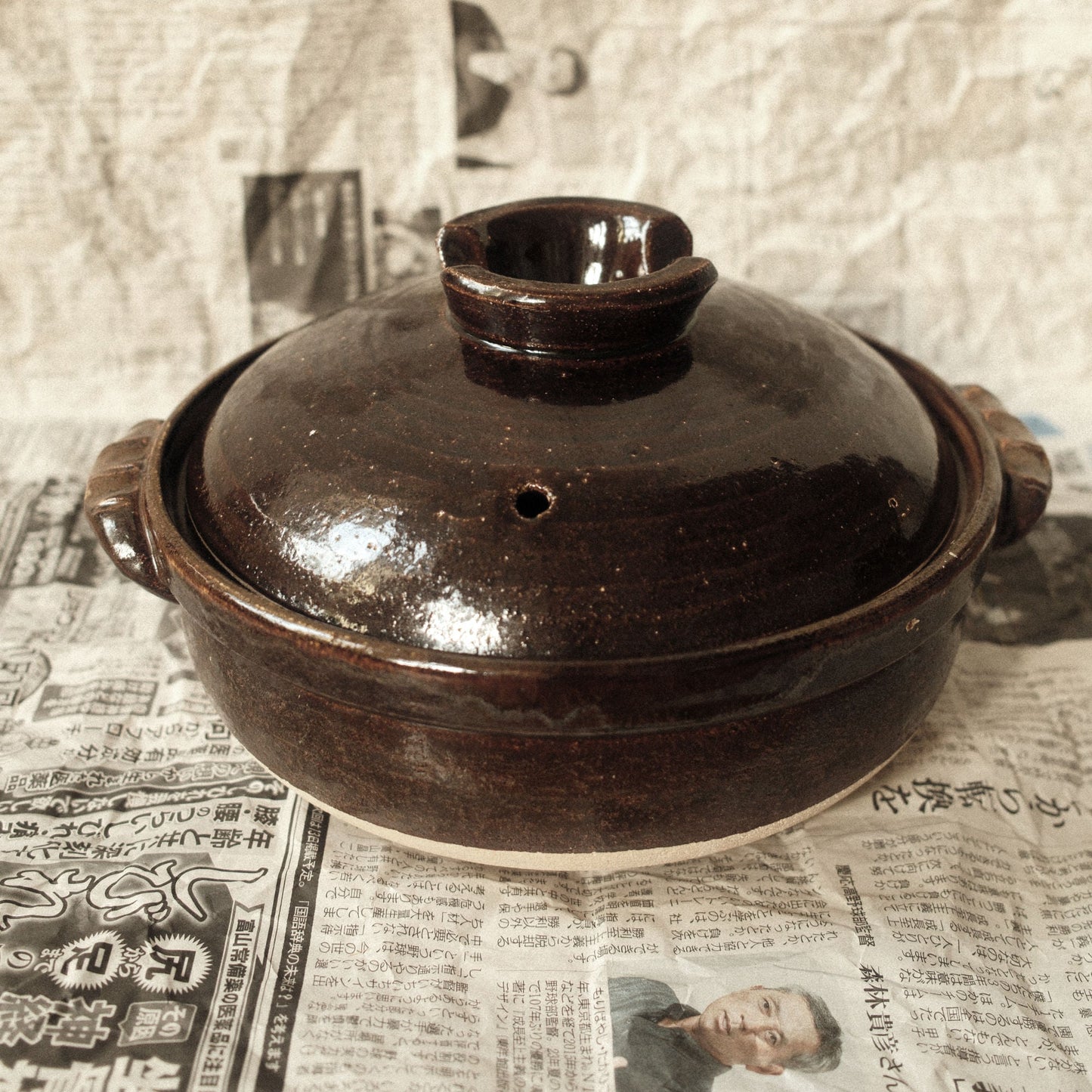

Iga Clay Donabe
Iga Clay Donabe
Couldn't load pickup availability
The Item
A traditional donabe is a thick-walled Japanese clay pot made for simmering, steaming, and slow, attentive cooking. You can think of it as an analogue forerunner to the crockpot.
This one is formed from Iga clay, fired until the surface vitrifies into a glossy, iron-rich brown that carries the soft irregularities of hand work: tiny pinholes, speckling, a slightly uneven rim.
The pot heats slowly and holds warmth long after the flame is gone. It rewards patience.
Over time, the interior develops kamado-haze, a subtle patina from rice starch, broth, and steam—a record of meals prepared, a literal 生活の跡 / seikatsu no ato, the traces of life.
NOTE: Not suitable for electric or induction cooktops. Iwatami portable gas burner sold separately for homes without a gasline.
The Artistans
Most Iga donabe are produced in small kilns around Marubashira, a pottery village active since the late 7th century.
The clay here is prehistoric—once the floor of Lake Biwa—and still holds microscopic silica and organic matter. When fired, those inclusions burn away, leaving tiny pores that allow the pot to breathe.
Many kilns maintain family lineages that stretch back centuries. Even when the maker isn’t individually named, the knowledge is collectively safeguarded across a continuity of hands, processes, and shared memory.
The Tradition
Donabe culture has roots in the Muromachi period, when communal meals were cooked in a single vessel placed at the center of the household. The idea has endured:
a donabe is not just a pot—it’s a piece of architecture for the table. Heat radiates outward. People gather.
Iga ware is known as one of the “Three Great Kilns” of Japan, prized for its durability and its ability to withstand direct flame. The dense, oxygen-starved firing creates a body strong enough for stovetop use, yet porous enough to develop flavor over time.
This is cookware designed to improve with wear—one of the purest expressions of Mingei values.
The Culture
In Japanese homes, the donabe appears during the colder months as a centerpiece for nabe, yosenabe, shabu-shabu, and slow-cooked rice. It signals something emotional: a shift toward warmth, gathering, seasonality, and taking time.
Iga donabe embody a very Japanese form of luxury— not perfection, but presence. Not smoothness, but texture. Not novelty, but longevity.
A pot that cracks slightly along the bottom from heat expansion?
That’s normal. It means the clay is alive.
This piece is the kind of object that becomes part of a household vocabulary—used weekly, aging honestly, carrying forward the imprint of every meal.
Share