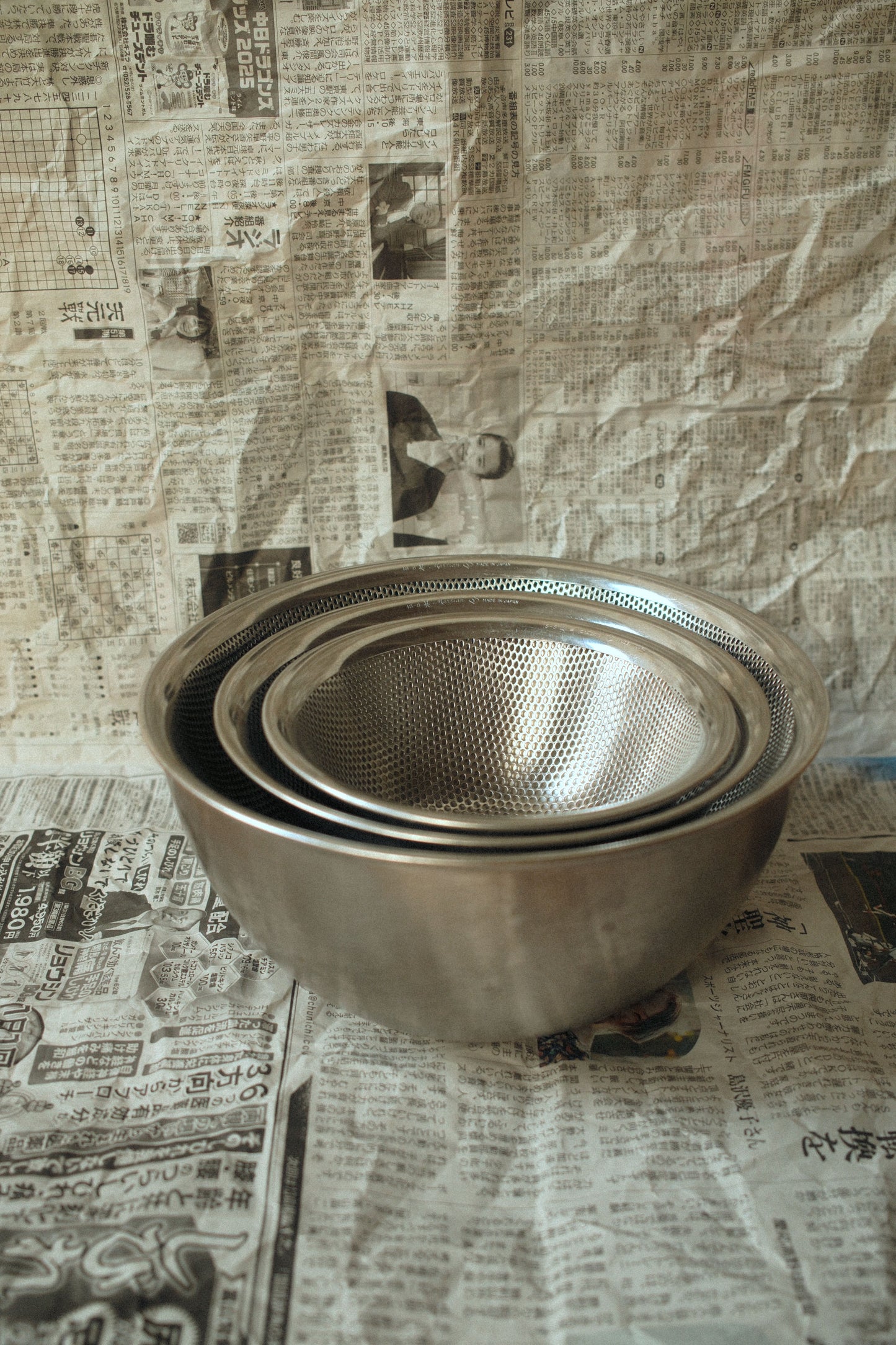

Sori Yanagi Stainless Steel Bowls & Colanders
Sori Yanagi Stainless Steel Bowls & Colanders
Couldn't load pickup availability
AVAILABLE FOR PRE-ORDER
The Item
This set of stainless-steel bowls by Sori Yanagi—industrial objects engineered to disappear into daily life. No embellishment, no flourish: just perfect proportions, a delicately rolled rim, and a weight that feels inevitable in the hand. They nest with a soft metallic hush, like the sound of a well-kept kitchen closing up shop. Each bowl's integrated colander makes straining rice, or rinsing vegetables, a dream.
Designed in 1960 and still produced in Niigata, they stand at the intersection of tool and sculpture: the kind of object that becomes more honest with use, picking up tiny marks, dulling slightly over time, holding seikatsu no ato (生活の跡): traces of life.
The Artist
One of Japan’s great postwar designers, Sori Yanagi was one of the few designers able to bridge the world of Mingei philosophy with industrial manufacture.
As a student of the great French designer Charlotte Perriand and the son of the Mingei Movement’s founder (Yanagi Sōetsu), Yanagi believe that good design is not invented but discovered. The form factor of his bowls, kettles, and utensils are not arbitrarily “styled," the way we often encounter branded. The final form was suggested to him, derived from continuous conversations with the hands, before being refined through repetition, and tested relentlessly in the kitchen. Yanagi called this process, “designing with the hands rather than the brain.”
These bowls are exactly that: thinking made tactile.
The Tradition
Japanese stainless-steel craft emerged in the mid-20th century, when postwar industries began adapting techniques from naval engineering and medical equipment.
Niigata, where these are made, became a center for metalworking, renowned for their precise forming, cold-rolling, and deep-drawing.
Yanagi leveraged this manufacturing culture to achieve what traditional craft alone could not: a bowl perfectly smooth, perfectly balanced, perfectly durable, but rooted in the same ethos as hand-thrown pottery: objects meant to live, age, and serve.
These bowls embody the Mingei belief that beauty resides in the everyday:
the rice you rinse, the vegetables you wash, the batter you mix.
The Culture
In Japanese kitchens, a bowl is not a passive container, but an extension of the cook:
a thing held, tapped, rinsed, warmed, and carried.
Yanagi’s bowls appear in homes, ryokan, tiny ramen shops, pastry labs, and school cafeterias. Their presence signals a vernacular, quotidian aesthetic, at once modest yet purposeful, unassuming but cared for.
The culture around these bowls is not luxury, but attention. An awareness that good tools are companions in daily life, and that the traces left on steel over years of cooking are not flaws but a quiet history.
Share