
Tanegashima Knife
Tanegashima Knife
Couldn't load pickup availability
AVAILABLE FOR PRE-ORDER
The Item
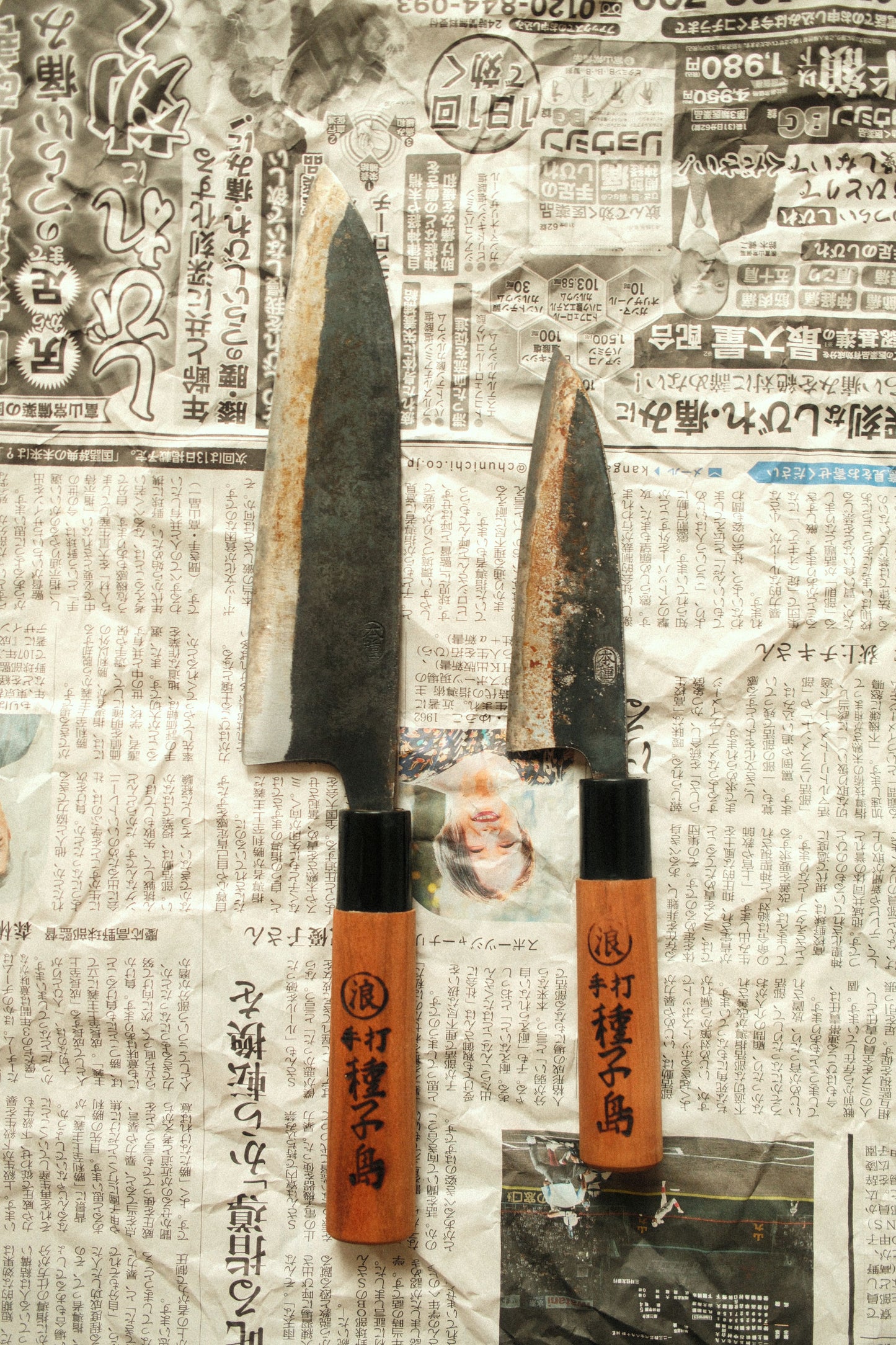
Forged on the remote island of Tanegashima, these knives carry the blunt honesty of tools made for work rather than worship. Each blade displays its history openly: carbon steel that patinas; a spine that remembers fire; and a handle that will darken from the oils of the hand that wield it.
This is a knife built with the expectation that the owner will participate in its becoming—sharpening, oiling, and carrying them is part of the object’s life, not an afterthought.
The pair you see here—one medium gyuto-like profile (Chef's Knife), one compact all-purpose petty—are from a small family forge where production remains slow, imperfect, and deeply human.
The Artist
The kanji on each handle reads 「浪打 種子島」(Namiuchi Tanegashima)—literally “Wave-forged, Tanegashima.”
It has one of the longest histories of steelmaking and bladecraft of any region in Japan. With the social upheavals at the end of the Edo era, the island's revered swordmakers and ancient smithies evolved into a single guild of bladesmiths producing knives, scissors and shears, making it one of the most productive centers of Meiji-era Japan.
This refers not to a single named smith but to a lineage of island blacksmiths working in the Namiuchi tradition: small coastal workshops where iron is heated, beaten, and quenched by hand, often just steps from the shoreline.
Because these knives aren’t made by a branded atelier but by working craftsmen, signatures vary, and no two blades are identical. In a way, the artistan is the island itself—with blades forged by human hands in conjunction with the island: its humidity, its salt air, its rust, its stubbornness.
The Tradition
Tanegashima holds a quiet, strange position in Japanese history. Bladesmiths have been active in this region dating back to the 12th century, making it the oldest and most-revered metallurgy center in Japan. It is was through Tanegashima that first Portuguese matchlock guns arrived in 1543, along with other foreign goods: tobacco, bread, and pivot scissors.
That legacy survives not in museums but in workshops like these: with humble smithies, like Master Knifemaker Tabata-San, producing practical tools for fishermen, farmers, hunters, and cooks.
The knives follow the kurouchi tradition—a blacksmith’s finish left intentionally raw to protect the blade and to honor the material’s origin. In Japan, this relationship between tool and owner is not a burden; it is the point.
The Culture
Owning a Tanegashima knife means accepting change as part of the object’s character. The island’s climate—rainy, maritime, mineral-heavy—invites patina and oxidation, and the blade responds accordingly.
Each use leaves a mark. Each meal alters its surface.
In Japanese craft culture, this slow transformation is not seen as degradation; it is seikatsu no ato (生活の跡 —) “the traces of living.” These knives don't just invite, but require participation: you need to wipe them dry, to oil the steel, to sharpen the blade, to acknowledge that use is a form of collaboration. That said, they make the most wonderful tools for home and professional chefs, alike.
Tanegashima knives echo the deeper rhythm of Japanese folk craft (Mingei): simple tools made with sincerity, meant to live alongside you, changing as you change.
Share