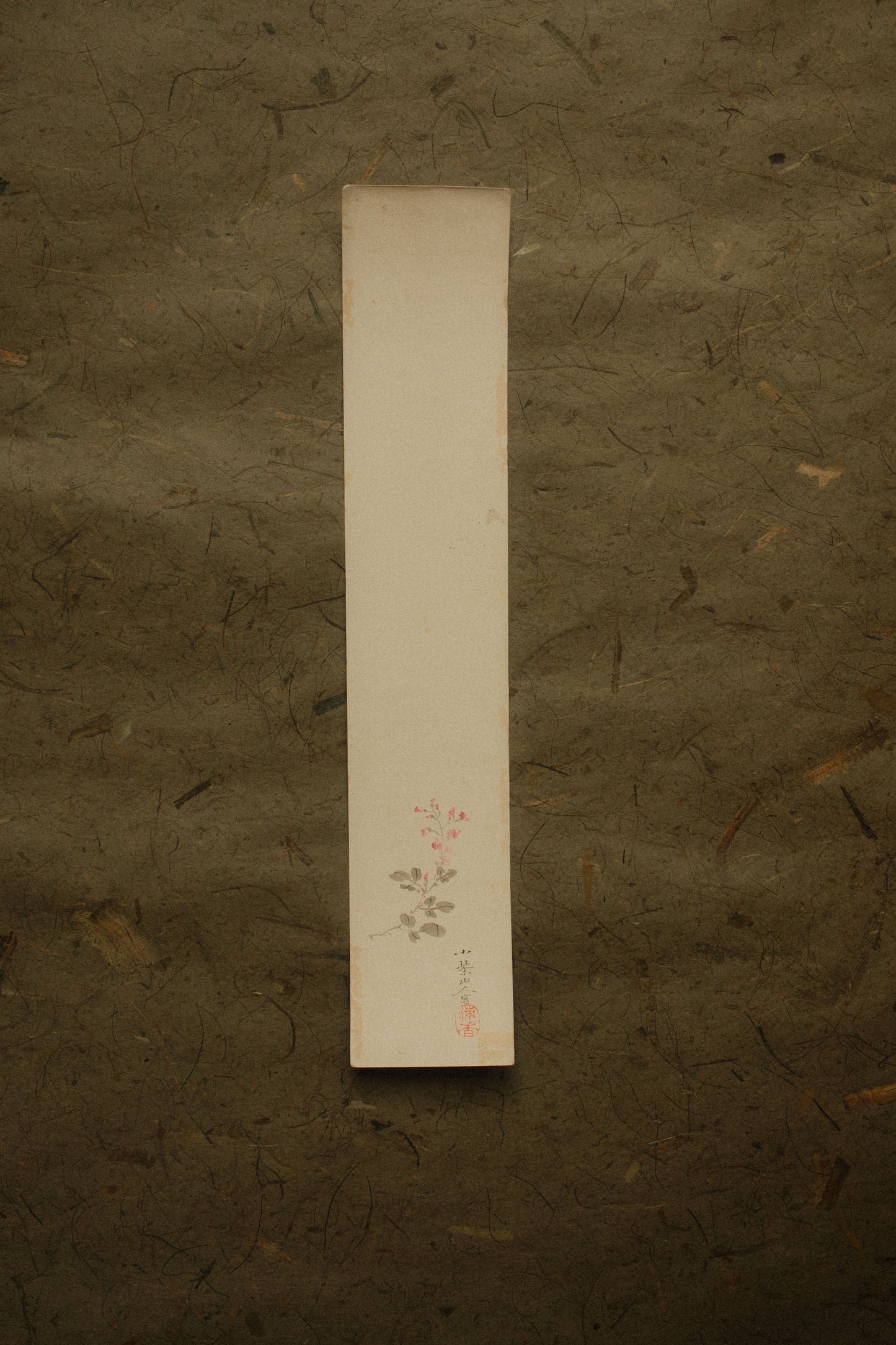

Tanzaku-e of 'Bush Clover' by Ransha, c. 1960s
Tanzaku-e of 'Bush Clover' by Ransha, c. 1960s
Couldn't load pickup availability
The Item
A suite of sixteen tanzaku-e (短冊絵) — hand-painted poem and illustration cards executed in ink and mineral pigment on handmade washi paper.
Each piece measures approximately 6–7 × 36 cm and depicts motifs drawn from classical kacho-ga (flowers and birds) and bunjinga (literati) painting: plum blossoms, bamboo, orchids, pine, rice stalks, and seasonal wildflowers.
This particular piece is more minimal and spare — depicting a delicate Japanese bush clover hagi — suspended in white space, making it one of the most elegant and culturally resonant pieces in our collection.
Collected in Kyoto, these tanzaku bear red seals (hanko) and signatures (gō) in both kanji and kana, each identifying the pseudonym of a different artist.
This artist's signature appears to be playfully self-deprecating, working within the Chinese tradition of scholar-artists who retreat into nature.
The delicate brushwork and variation in tone suggest a mix of professional and semi-professional nihonga painters working in Kyoto during the mid-to-late Shōwa period (1950s–1980s). This piece is most likely from the 1960s.
The Artist
Each artist signs their tanzaku-e under a poetic gō — a pseudonym derived from classical Chinese and Japanese literati custom.
Names such as Setsugaku (“Snow Peak”), Gyokusen (“Jade Spring”), Hanpō (“Half Peak”), and Shōan (“Pine Hermitage”) evoke nature, solitude, and the pursuit of inner cultivation through art.
While individual biographical records are rare, the coherence of brush style and paper stock suggests these painters belonged to a Kyoto tanzaku workshop, calligraphy circle, or small art-supply gallery network (such as Unsōdō or Rakusensha), where tanzaku-e were sold for tea gatherings, gifts, and seasonal decoration.
The Tradition
Tanzaku-e originated in Edo as vertical poem cards used for inscribing waka or haiku. From the Edo period onward, they became a favored format for haiga (haiku-painting) and small kacho-ga compositions, and prized for their intimacy and economy of brush.
In the twentieth century, Kyoto’s nihonga painters revived the form, marrying literati brushwork with a modern sensibility that was concise, contemplative, and suited to the domestic scale of Japanese interiors. These tanzaku stand within that lineage, preserving the formal restraint and spontaneity of the bunjin tradition while adapting it to a postwar decorative context.
The Culture
Each painting embodies a distinctly Japanese aesthetic of shibumi (quiet refinement) and mono no aware (the pathos of transience). The subjects—bamboo bending in wind, a single blossom on bare branch, the poised arc of a rice stalk—reflect not spectacle but the beauty of restraint.
In Kyoto, such works were exchanged among friends, poets, and tea practitioners as expressions of season, mood, or gratitude.
To a contemporary viewer, they offer a window into Kyoto’s living craft culture, one where the line between art and utility, practice, and philosophy, is gracefully porous.
Share