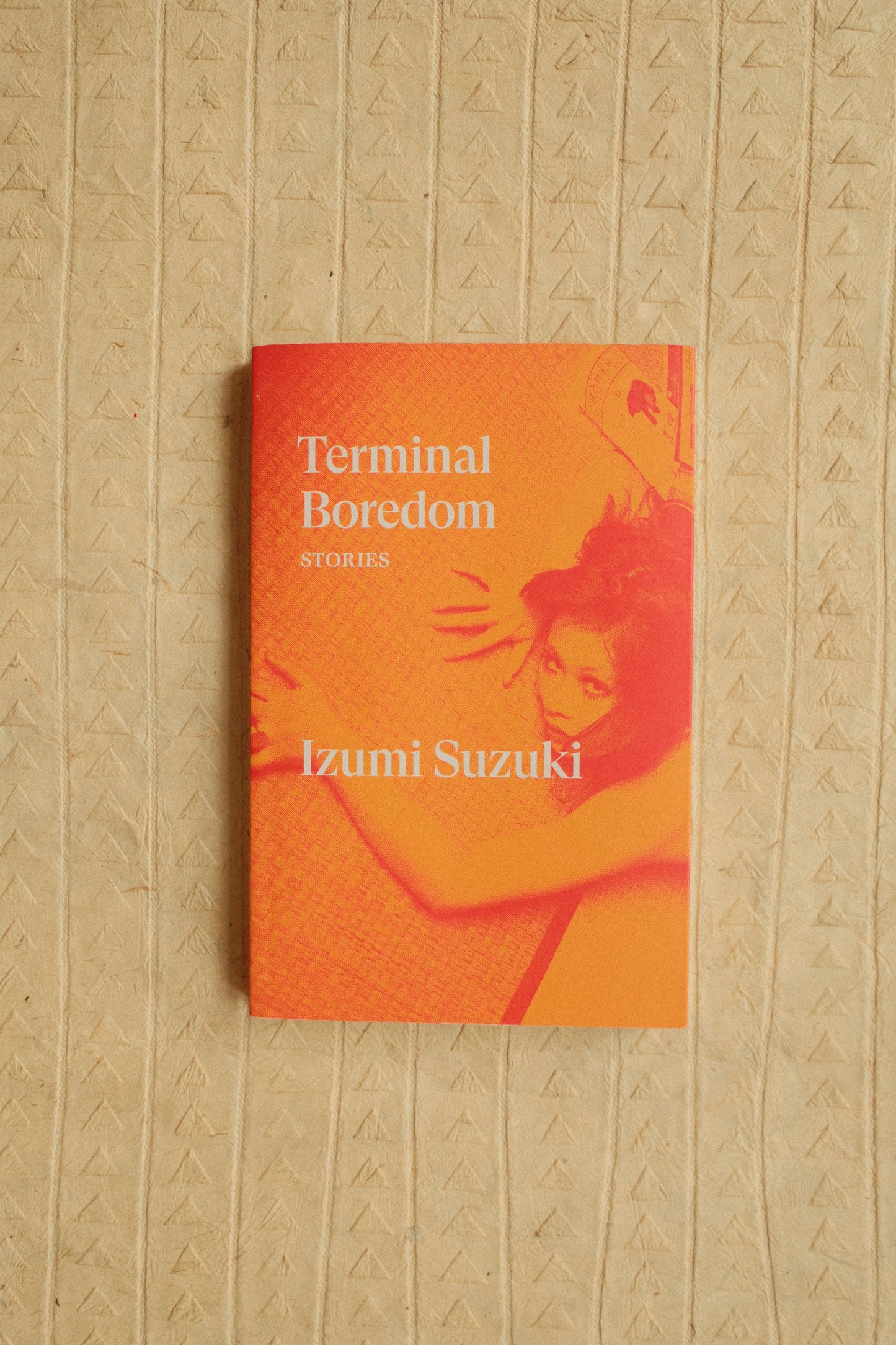

Terminal Boredom by Izumi Suzuki
Terminal Boredom by Izumi Suzuki
Couldn't load pickup availability
AVAILABLE FOR PRE-ORDER
This collection of Izumi Suzuki's short stories feel like they have been beamed from the future, or perhaps the past, a reminder that time rarely goes one way. Punk, prophetic, and deeply disillusioned, she saw the collapse of gender, technology, and modern love long before we did. Reading her feels like catching up with a ghost, or an imaginary friend, at a bar.
Japan’s “it girl” of the 1960s and 70s, Suzuki’s life was as varied, fantastical, and bleak as her prose. If Eve Babitz chronicled Los Angeles through cigarettes, parties, and heartbreak, Suzuki did the same for postwar Tokyo, trading Hollywood glamour for Shinjuku neon, and sexual liberation for something stranger, colder, more existential. Both turned their lives into mythologies of desire and disillusionment; both blurred the line between muse and author, beauty and critique.
–
Initially finding work as a typist, upon moving to Tokyo Suzuki began working as a hostess, a nude model, and acting in pink films—soft-core pornographic films produced by the Yakuza—which led her to being “discovered” by Nobuyoshi Araki, the Japanese erotic photographer with whom she cultivated a decade-long working relationship.
She broke into science fiction’s male-dominated writing scene almost by accident, bringing with her a voice that alternated between rawness, sarcasm, and tenderness. The worlds she writes are strange but familiar, populated by lonely girls, disaffected lovers, cyborgs and aliens struggling to articulate feelings they can't name.
In a genre obsessed with the future, Suzuki wrote with urgency about the now: alienation, capitalism, and the quiet despair of city life. She made the speculative feel intimate, the erotic feel existential.
After a tortuous marriage to the experimental jazz musician Kaoru Abe—who died of a Bromisoval overdose in 1978, just a year after their divorce—Suzuki took her own life in 1986 at the age of thirty-six, the same age as Princess Diana and Marilyn Monroe. Their chaotic relationship haunts her first novel, Set My Heart on Fire Immediately (1983), and later inspired Kōji Wakamatsu’s film Endless Waltz (1995).
Like Babitz, Suzuki understood that style as a form of truth-telling. And like all futurists, she wasn’t predicting what was to come, but describing what was already here...only no one else could see it, yet.
Share