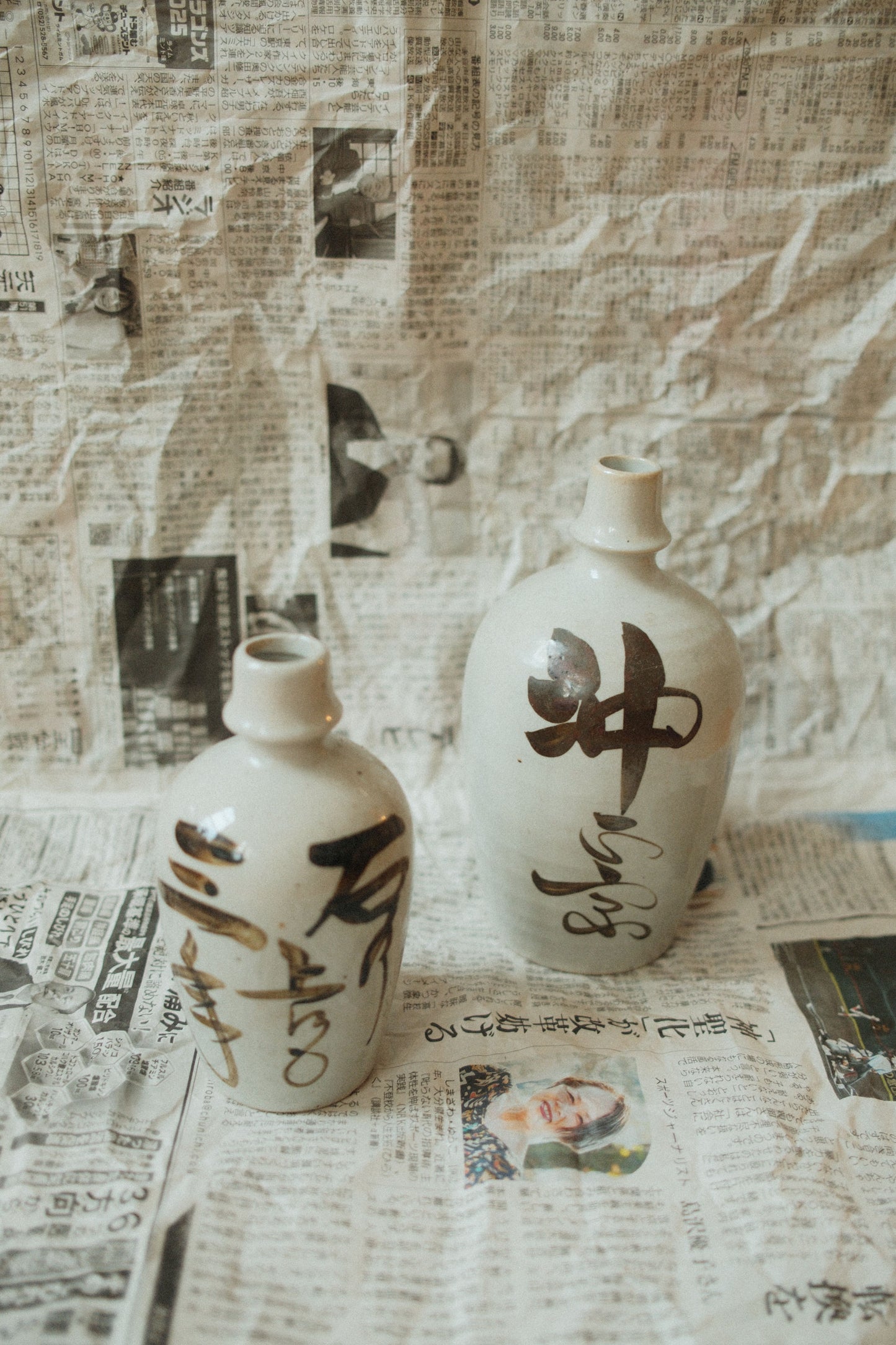

Tokkuri Sake Bottles
Tokkuri Sake Bottles
Couldn't load pickup availability
The Item
These two hand-thrown tokkuri (sake bottles) carry the quiet authority of everyday Japanese ceramics: objects made not to impress, but to be used until they soften into the rhythms of a home. Their surfaces are brushed with bold, gestural calligraphy, made up of strokes more evocative of movement than language. Each bottle shows the slight irregularities of studio kiln work: subtle warping, pooling glaze, the faint grain of the potter’s wheel.
They hold 1–1.5 servings of warmed sake, but they also stand beautifully empty, like sculptural punctuation marks in a room.
The Artistans
The calligraphy suggests a Shigaraki or Mino regional workshop, probably from the mid-to-late 20th century. The brushwork is expressive and informal, likely at a kiln where potters and calligraphers collaborated, a very common practice in rural ceramic towns from the 1950s–1990s.
These aren’t mass-produced restaurant vessels; they were almost certainly sold directly from a pottery shop or roadside kiln during a regional festival or seasonal market.
The Tradition
Tokkuri are part of a long lineage of functional folk ceramics that formed the backbone of the mingei craft movement—the philosophy that beauty comes from everyday use, not elite art objects. The brushed characters evoke ebisugaki style calligraphy: rapid, intuitive, celebrating imperfection and openness.
The slightly elongated necks and rounded bodies are prototypical shapes meant for warming (kanzake) by placing the bottle directly into a pot of hot water. Their shapes come from centuries of iteration—each curve dictated by the hand, not the idea.
The Culture
In Japan, sake bottles like these exist at the intersection of hospitality, seasonality, and memory. They appear at small gatherings, with the first drink always poured for the guest, sharing the warmth of the home. The calligraphy isn’t merely decoration, but a gesture of welcome, and a moment of personality from the maker to the eventual drinker.
Placed in an American home, they hold the same energy of the tokonoma: quiet presence, a reminder of an everyday aesthetic that values use, repetition, and the traces left by living.
Share